How Rep5x Brings 5-Axis, Support-Free Printing to Consumer Machines
Overview
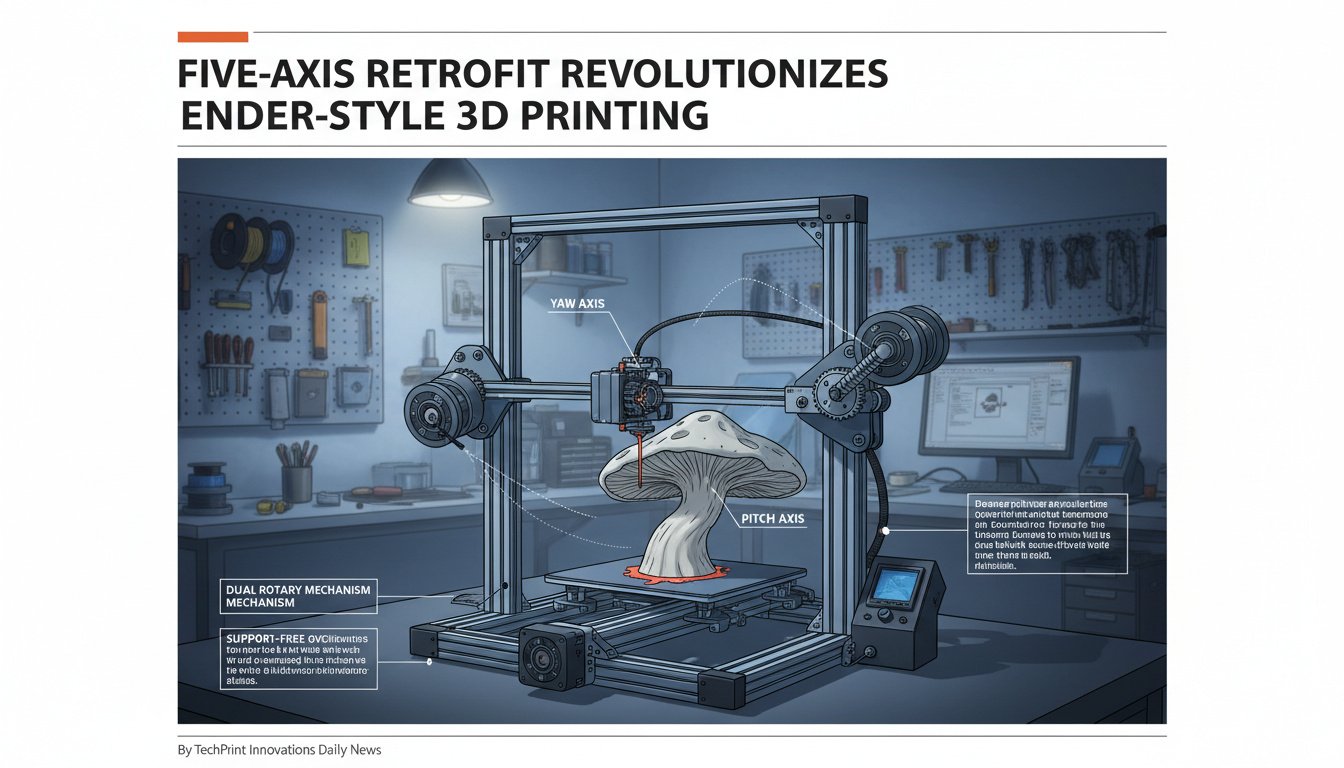
Rep5x is an open source retrofit that enables true 5-axis printing on common consumer DOF machines such as the Ender 3 V3 and Ender 5 Pro. By adding two rotational axes, yaw and pitch, to the existing Cartesian motion, Rep5x lets you orient parts during printing so complex overhangs can be built without conventional supports. The project was published on Reddit today and the full firmware, bill of materials, and build instructions are available on GitHub.
How Rep5x Works
Rep5x combines mechanical modifications, firmware changes, and slicer workflows. Mechanically, it adds two rotating stages to the print head or bed to provide the additional degrees of freedom. Firmware accepts new kinematics so the printer translates 5-axis motion into coordinated motor steps. On the slicing side, models are sliced into toolpaths that account for continuously changing orientations, preventing unsupported features from ever pointing directly downward.
Key elements:
– Two additional rotary joints: yaw and pitch.
– Modified firmware with inverse kinematics for 5-axis motion.
– Slicing profiles or postprocessors that generate multi-axis toolpaths.
Installation and Compatibility
Rep5x targets popular, inexpensive printers to maximize accessibility. The hardware BOM is designed to use off-the-shelf rotary bearings, stepper motors, drivers, and 3D-printed brackets. Installation requires moderate mechanical skills and basic electrical wiring. The project provides step-by-step assembly instructions and wiring diagrams.
Compatibility notes:
– Best suited to printers with a strong, rigid frame and accessible mounting points for rotary modules.
– Some builds attach the rotary axes to the hotend carriage; others mount them under the bed. Choice affects part orientation limits and print volume.
– Firmware updates are required. Users should follow the provided firmware branch to avoid bricking the controller.
Practical Benefits
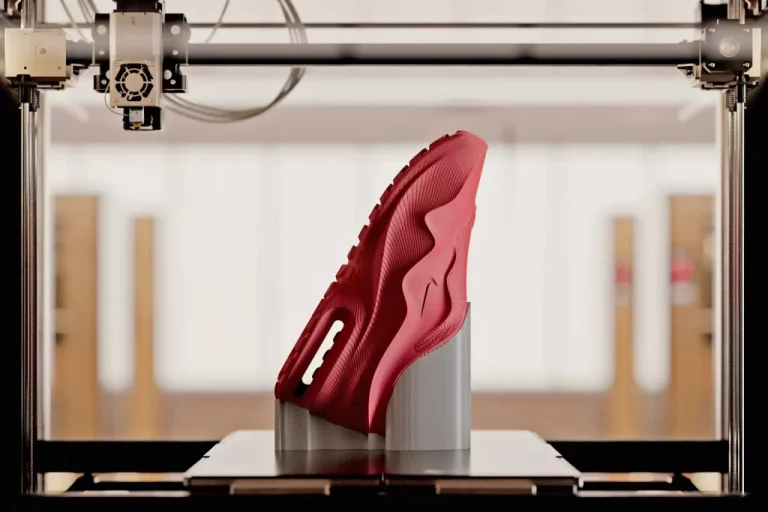
– Support-free printing: By reorienting features as they print, many complex geometries that would normally require supports can be produced without them, reducing post-processing.
– Improved surface quality: Avoiding support interface scars improves final finish and reduces material waste.
– New design freedom: Designers can exploit continuous orientation changes to create forms not practical on fixed-axis FFF machines.
Limitations and Considerations
– Complexity: The system adds mechanical, firmware, and workflow complexity compared with standard 3-axis printers.
– Slicer maturity: Multi-axis slicing workflows are still evolving. Some manual tuning and custom postprocessing may be required for reliable results.
– Print speed and reliability: Added axes and continuous motion coordination can slow prints or increase points of failure. Proper calibration is essential.
– Toolhead clearance and collision risk: Rotations change the spatial envelope of the toolhead. Careful collision maps and limit switches are necessary.
Use Cases
– Organic shapes with steep overhangs that normally need supports.
– Functional parts where support removal would damage small features.
– Prototyping for production processes that will use multi-axis machines.
– Makers and educators exploring advanced kinematics and open hardware.
Community and Future
Rep5x illustrates how the maker community can push consumer hardware forward through open source development. The project includes firmware forks, a parts list, build guides, and example prints. As the community contributes more slicer integrations and refined mechanical kits, expect usability to improve and more turnkey retrofit kits to appear. Integration with mainstream slicers or native multi-axis toolpath generation would be the next major step.
Original post: Rep5x is now fully open source; here’s a mushroom?
This page contains affiliate links and I earn a commission if you make a purchase through one of the links, at no cost to you. As an Amazon Associate I earn from qualifying purchases.